Overtime was normal on our team back then. I had the tightest schedule of anyone, and I was the one going home on time.
There’s a saying I like. Lazy people change the world. I wasn’t trying to change the world. I just wanted to get out of the office on time.
Three projects at once, all three mine. Each one needed models and drawings every 15 to 30 days, with production right behind.
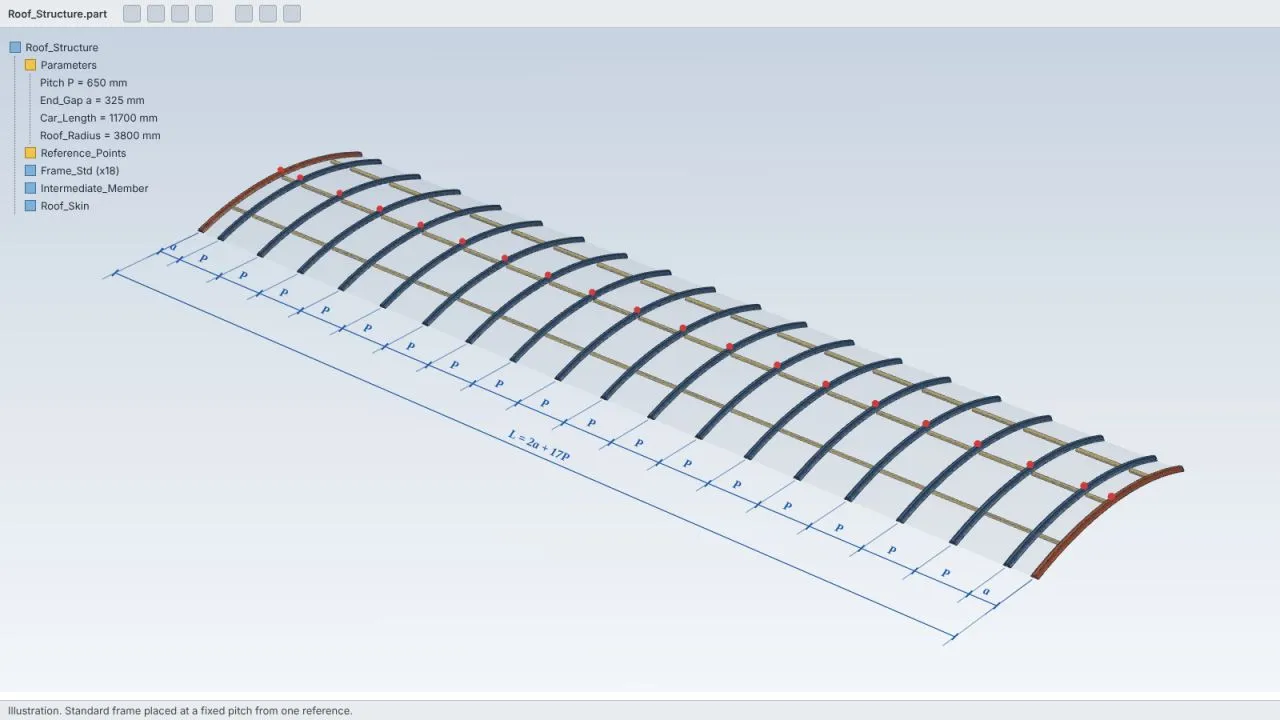
I was designing car body roof structures. The usual way was to fix both ends and space the frames evenly between them. But the only rule was a maximum spacing. So I placed the frames at one fixed pitch from a single reference and split whatever was left between the two ends. The end gaps came out shorter than the rest. Still within the rule.
We had just moved from CATIA V4 to V5, and V5 made parameter-driven models possible. So I spent almost a full month, in the middle of all three projects, working out how far that could go and building one standard model. Most days I was in by 6:30 and out at 7 or 8. By the end it was tested, with the drawings linked to it.
First project, model included: 1 month. Second: 15 days, home on time. Third: 10 days, and this time that included the drawings. Open the base model. Enter the dimensions that change. Adjust the contours. Update. Drawings done.
That covered the whole roof, the HVAC section included. The one part I couldn’t standardize was the HVAC air inlets and outlets. Each project had a different HVAC supplier and different requirements, so the model had to be adjusted around them. That’s why it never got below 10 days. Later they settled into two or three versions each, and I got some of those built in too.
The standardization helped the supplier too, which I’d expected. The same pitch on every project meant the parts between the frames were the same too. To start production, they only needed the main frame count and the main part drawings. From what I heard, the unit price came out well for us. I’d guess the supplier didn’t mind either, since it kept winning the next jobs. And delivery got easier because the standard parts were already made.
Later I presented it internally, taught a few people to use it, and talked with colleagues on other parts, like the underframe, about using it there. Then I moved to a different team. I sometimes wonder whether they still build roofs this way.
Someone once told me it wasn’t lazy at all, that I’d worked harder than anyone. Maybe. But the plan was to go home on time, and it worked.
That lasted until I volunteered to design the detrainment ladder.